Specialized Executive Function work

Individual sessions for neurodivergent adults who have or suspect ADHD.

I have a hard time getting started.
I wish I had the spark to finish projects.
I lose time without meaning to.
Things around me have really started to pile up.
Life is starting to feel like Groundhog Day.
I really want to wake up, make a plan, and stick to it.
I’m tired of ghosting myself on goals I set.
I’m exhausted from masking at work all day.
I’ve been on 100 first dates, and I’m starting to think the problem is me.
I hate that my first thought is always negative.

Ready for some real talk?

I know if I sit down, I’m probably not getting back up.
I know I need to finish this before I start something else.
I know I need to get to bed earlier.
I know I’m really good at ignoring a timer.

I know. I know. I know.

And yet knowing hasn’t translated into anything more than knowing.

You’ve been to therapy before. Talking about “it” hasn’t really changed your day-to-day.

You’ve bought endless planners and organization systems. You’ve tried the tips and tricks your therapist has given you. You’ve even kept your sneakers on in the house because a TikTok reel told you it would help with activation.

And the truth is, some of it worked.

It just didn’t keep working.

So of course you’re hesitant to try something else. There’s the existential dread of adding one more thing to the list, and part of you may genuinely be wondering whether your ADHD brain is ever going to change.

But this work isn’t about finding you another timer, planner, or system.

Sometimes we’re learning an executive-function skill you were never actually taught. Sometimes we’re unlearning an automatic response that used to help but is now getting in your way. Sometimes we’re trying something, collecting data, understanding why it did or didn’t work, and adjusting from there.

We’re learning, unlearning, trying, understanding, and adjusting.

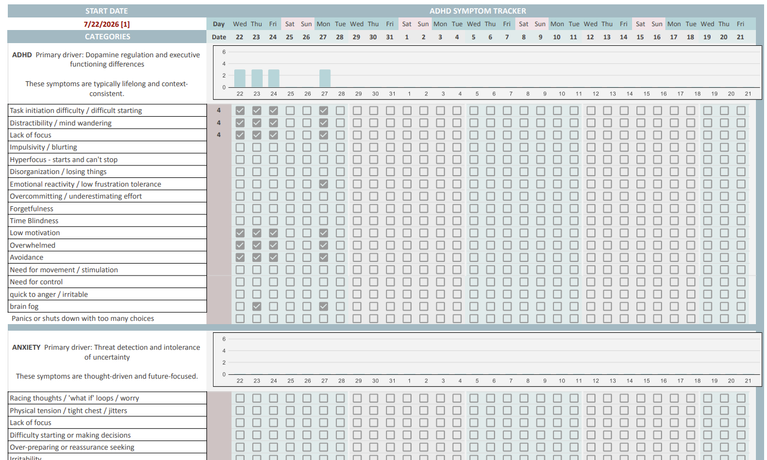
This is an example of how we’ll track what is going on throughout your day and be able to identify if the main cause is ADHD or if it is due to
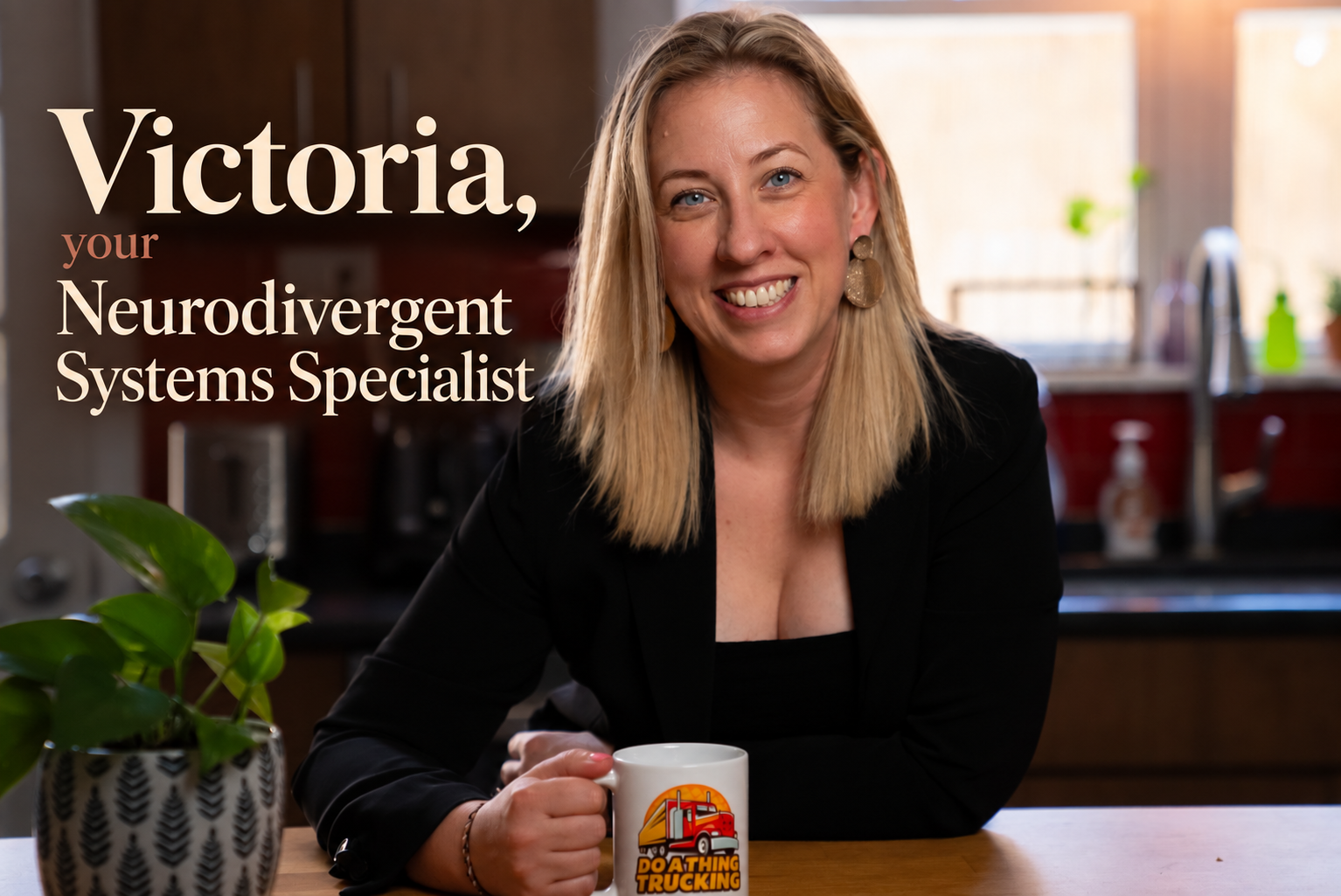
Victoria Prisco, Neurodivergent Systems Specialist, smiling at her kitchen table with a coffee mug.

This is the scope of our work

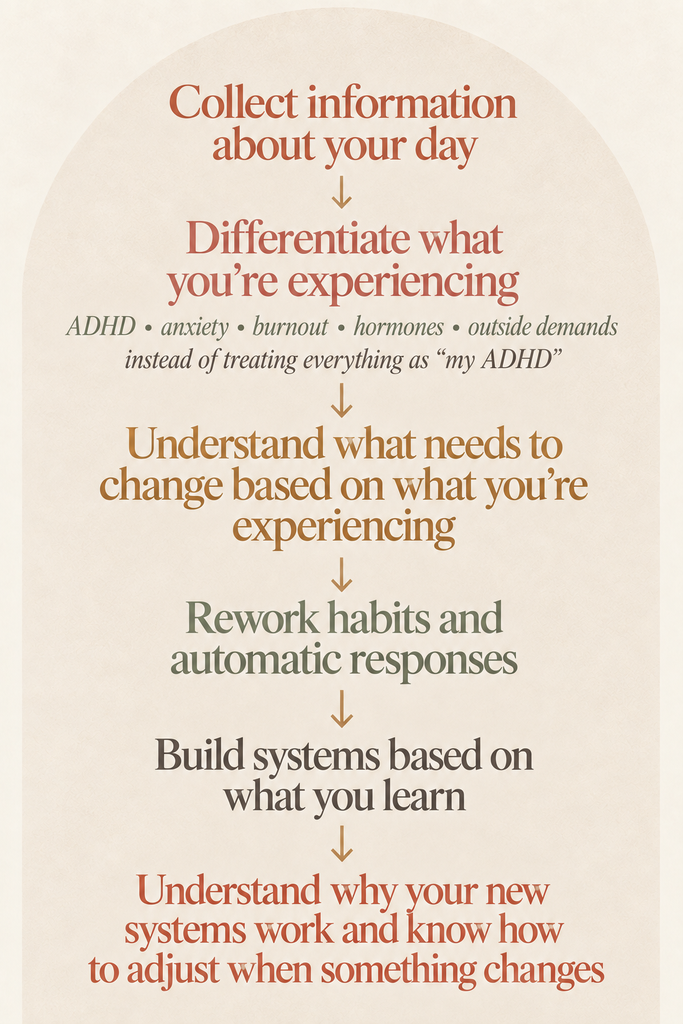
  • This work isn’t about hacks. It’s personalized to you. To do this, we start by gathering information about your day and/or responses and using your personal data to paint the picture.In session, we’ll process your data together. For example:
    Did you wind up with 15 unfinished work tasks because you kept stopping and starting something new?
    Prior to data tracking, did you recognize how many times someone higher up reset your day and asked you to reprioritize, which is actually why you have 15 unfinished tasks?
    Or is an anxiety response holding you back from completion? You worry things aren’t good enough, so you put off hitting send on that email or putting the final touches on a presentation.
    Did you take a lunch break?
    At the end of the day, are you totally burnt out, and is that a leading factor in why you can’t show up for your personal to-do list?
    ADHD, anxiety, perfectionism, burnout, and external forces all require different interventions. They also have symptoms that overlap, which is why you can find yourself assuming everything is just ADHD acting up again.
    When we work together, we’ll break all of this down, and I’ll teach you how to identify what’s actually what.
  • Our 30-minute sessions are intentionally focused and aren’t an open-ended How did your week go?
    Think of our meeting like a stand-up meeting. We have 30 focused minutes to process the information you’ve gathered, work on the strategy, skill, habit, or response we’ve identified, and decide how we want to move forward.
    The structure itself is part of the work. You’re practicing how to synthesize what you want to say and stay on topic instead of letting a thought loop take us down a rabbit hole. We work on recognizing when the scope needs to adjust or when another iteration needs to be added.
    The time is intentional so you walk away having retained what we worked on instead of thinking, Wait… what did we even do?
  • We meet every two weeks. That’s about an hour a month. You’ll collect data, do homework, and put a plan in motion in between.
    Yes, that’s right. Working together means our work doesn’t stop when the clock hits 30 minutes.
    You’ll use the time between sessions to practice what you’re learning, try the plan we created, and collect information about what happens when you put it into your day-to-day.
    This isn’t about finding the right productivity hack or system. And we aren’t doing a deep dive into your childhood trauma to unearth a system.
    It’s about changing fight-or-flight responses. Learning how to set boundaries with yourself and others. Learning time, and then time management. Rewriting a rule you taught yourself, like I work better in the morning, and building flexible thinking so that if you don’t start until the end of the day, you got started instead of scrapping the whole thing until tomorrow.
  • Because the goal isn’t to find you a planner that works until it doesn’t. We put systems in place. We build habits. We reshape thoughts so your day-to-day starts feeling more aligned and you feel more like the person you want to show up as.
    And when we part ways, you leave with the education and skills to recognize when something needs to change and start making that change yourself. Maybe it’s a system. A thought. A plan. The way you’ve organized something. The scope of what you’re asking yourself to do.
    Because something will change. Your capacity will change. Your environment will change. Life will change. The goal is for you to know what to do when it does.
  • I could keep going, but you get the gist.
    I won’t bore you with all the nitty gritty on this page. But if you want to nerd out, you can read more about how learning, unlearning, automatic thoughts and responses, experimentation, executive-function skills, and project management all come together in our work. And how all of this helps you keep doing the work long after we’ve stopped working together.

    Take me down the methodology rabbit hole
  • There’s a reason my approach pulls from a few different places.
    I’m a former Special Education Teacher turned Creative Arts Therapist, Licensed Professional Counselor, Project Management Professional, and Menopause Coach. I’ve focused my work on helping neurodivergent individuals since 2009, and each part of my education and experience shows up in how we’ll work together.

How to get started

one

Introduction Sesh

30-minute video call. No obligation to book further.
Let’s meet, talk about what you want to work on, and make sure this feels like a good working relationship.

two

Craft Your Strategy

See how 30 minutes feels. Set the scope. Report out on past trials and errors. Share any additional information that may change the scope or deliverable.

three

Launch

If we decide to work together, you’ll book a regular day and time to meet every other week.
We’ll set your first homework in motion and create a working agenda for our next session.

Still in your DIY era?

Give how we work together a try before you even schedule an introduction session.
Download Before you blame your ADHD and set the intention to use page 2 to start your workday three days this week.
At the end of the week, look back over page 2 and complete the reflection. Notice what you learned from your data.
Maybe you finish thinking, I’m interested. I’d try more of this.

And yes, there’s accountability built in.
I’ll be your accountability buddy and send you an email at the end of the week to see if you did the work and how it went.
And maybe that’s the moment you think, Okay, this is the kind of systems relationship I’ve been looking for.

Name(Required)
Email(Required)
Privacy(Required)

Posted on Google Google
A G profile picture
A G
Google star 1Google star 2Google star 3Google star 4Google star 5Trustindex verifies that the original source of the review is Google.
My son has thoroughly enjoyed his experience in the Minecraft therapy group this summer. He is connecting with other like-minded kids and playing one of his favorite games even as he is learning and practicing critical SEL skills. Victoria expertly guides kids through challenges that naturally arise in group play and keeps them focused on their goals. He is already looking forward to the next session!
Posted on Google Google
K H profile picture
K H
Google star 1Google star 2Google star 3Google star 4Google star 5Trustindex verifies that the original source of the review is Google.
My son had two tough years in school. Has ASD and ADHD. He struggles with controlling his emotions. He has done in person social groups before and they would sometimes go good but it wasn’t consistent. I kept seeing the ads for a Minecraft social group. I asked his therapist what did she think and she said it sounds like a good idea. Our son started attending the Minecraft social group and had a couple tough sessions initially, but now that we are over half way through it’s amazing to see the difference. Victoria is amazing. I have seen our son enjoy being a part of the group and even has stayed online 2 hours after group playing with another child. Being in a secure server online helped me with making sure he was in a safe online setting. After one session, he came running outside to tell me that he got an award from Mrs. Victoria and I would receive an email. He was beaming with pride and excitement. I checked my email and sure enough, I had a Kind Leader Award that I printed out with his name on it. This group has helped him work through frustrations, listening to others, taking turns and making friends. We have seen a big decrease in his emotional outbursts and meltdowns since starting the social group. I highly recommend Victoria and her Minecraft social group!
Posted on Google Google
K N profile picture
K N
Google star 1Google star 2Google star 3Google star 4Google star 5Trustindex verifies that the original source of the review is Google.
The Minecraft Social Skills Group has been a positive experience for my son. He looks forward to it every week. I love seeing him connect with others and to see his excitement. Victoria does an excellent job keeping the kids on track and working with them to navigate strong feelings appropriately. Im very glad we found this group as it is the first activity I signed him up for that he does not try to get out of going.
Posted on Google Google
D C profile picture
D C
Google star 1Google star 2Google star 3Google star 4Google star 5Trustindex verifies that the original source of the review is Google.
My son has participated in a Minecraft group therapy cohort and it has been so great to see him interact and grow in his ability to listen, wait, and game cooperatively. Victoria is great in this setting, helping the students to "be" with each other in a safe space, and helping them to problem-solve and troubleshoot together.
Posted on Google Google
M K profile picture
M K
Google star 1Google star 2Google star 3Google star 4Google star 5Trustindex verifies that the original source of the review is Google.
We love this cohort for my neurodiverse kiddos. They enjoy the comradery and don’t even realize they are actually learning how to socialize better. My oldest is quiet and not very social, but the group has brought out his social side. My youngest deals with impulsivity and speaking out of turn. He’s learning patience and to wait to speak. I can see a difference in the way they are handling interaction now. I can totally recommend this cohort for any type of neurodiverse kiddo. Your kiddos will love it!
Posted on Google Google
A G profile picture
A G
Google star 1Google star 2Google star 3Google star 4Google star 5Trustindex verifies that the original source of the review is Google.
My 8-year-old with ADHD/ASD absolutely loves being part of this Minecraft Social Skills group! He is very comfortable with his peers and enjoys interacting and collaborating with them in their virtual world. Since he started about 7 months ago, he has become more adept at managing his emotions and flexible in adapting to change--which is huge for him--and seems happier at school, home, and out in the world. Victoria is very responsive to parent concerns and regularly communicates about how he's doing. I highly recommend this group for any kid who loves video games and could use some social guidance!
Posted on Google Google
S D profile picture
S D
Google star 1Google star 2Google star 3Google star 4Google star 5Trustindex verifies that the original source of the review is Google.
We cannot say enough positive things about this Minecraft cohort. Our 8-year-old has ADHD, Autism, and Generalized Anxiety Disorder, and finding a space that feels both safe and engaging has always been a challenge. This program exceeded our expectations in every way. The structure is thoughtfully designed with neurodivergent kids in mind. Ms. Victoria clearly understands how ADHD brains work, there’s enough freedom to explore and create, while still providing gentle guidance and consistency. Our child stayed engaged without feeling overwhelmed or pressured, which is something we rarely see. What truly stood out to us was the peer support aspect. The cohort fostered a kind, accepting environment where differences were normalized and respected. Our child felt understood, not singled out. They were able to practice social skills naturally through gameplay, collaboration, and problem-solving, all while building confidence and friendships at their own pace. For anxiety, this program was a game changer. The familiar and comforting Minecraft setting helped reduce stress, and the predictable routine made participation feel safe. We saw our child become more comfortable speaking up, taking initiative, and handling small frustrations ; skills that are incredibly hard to teach in traditional settings. As parents, it was incredibly reassuring to see our child genuinely excited to attend, proud of their creations, and happy to talk about the friends they made. This cohort is more than just a Minecraft group, it’s a supportive community that truly understands neurodivergent kids. We highly recommend this program to any family looking for a meaningful, well-run, and compassionate social experience for their child. We will be returning with our child, hopefully in the next cohort!
Posted on Google Google
J N profile picture
J N
Google star 1Google star 2Google star 3Google star 4Google star 5Trustindex verifies that the original source of the review is Google.
Victoria is incredibly knowledgeable and compassionate, especially when it comes to supporting clients with ADHD and challenges related to executive function skills. She creates a space that feels both safe and empowering, helping clients build practical strategies that actually work in real life. Anyone in Philadelphia, PA looking for thoughtful, effective support around ADHD would be in excellent hands here.
Posted on Google Google
S F profile picture
S F
Google star 1Google star 2Google star 3Google star 4Google star 5Trustindex verifies that the original source of the review is Google.
Highly recommend! The immense knowledge combined with the sound practical help given is basically magic! Tell your friends, share the contact, you will be well on your way to progress!
Posted on Google Google
C E profile picture
C E
Google star 1Google star 2Google star 3Google star 4Google star 5Trustindex verifies that the original source of the review is Google.
I've had the pleasure of working alongside Victoria and can confidently say she is an incredibly compassionate, skilled, and dedicated therapist. Her ability to create a safe, supportive space for clients is truly admirable. She brings deep insight, empathy, and professionalism to every session. I highly recommend her to anyone looking for meaningful, effective support in their mental health journey!
Verified by Trustindex
Trustindex verified that these reviews were published on Level up Wellness's Google Business Profile. Learn more

Get To Know Your Systems Specialist

let’s do this

Ready to level-up and stop second guessing yourself?