Specalized Executive Function Support for Women Navigating Hormonal Changes
Pregnancy • Postpartum • Perimenopause • Menopause
I used to be able to do this.
I thought I would have accomplished this by now.
This isn’t how I pictured this stage of my life.
I don’t know who I am now.
I don’t know what comes next.
I know I can’t keep living this way, and something needs to change.
I should lose the weight.
I should get back to the gym.
I should finally organize the house.
I should be better with money.
I should figure out what I’m doing with my career.
I should date differently.
I should look better.
I should have more energy.
I should get my shit together.
You’re leaving behind a life you knew while learning how to live the one taking shape.
You want answers, a concrete plan, and a way to put what you learn into practice.
You don’t need an ADHD diagnosis or a complete vision for your future to do this work. As we work together, we’ll weave in identifying your longer-term vision, setting goals toward your next steps, and putting those goals into motion. I’ll be your accountability buddy.
And we won’t just improve your executive functioning. We’ll get to the root of what needs to be learned, unlearned, adjusted, or reshaped so you understand how to keep doing this work long after we’ve stopped meeting.
Life is busy, you’re already stretched thin, and I know you’re only going to skim this. So let me get to the point.
- We’re going to figure out what’s actually what.
- What’s hormonal?
- What’s ADHD?
- What’s a fight-or-flight response?
- What’s anxiety?
- What’s burnout?
- What’s existential dread?
- The list goes on.
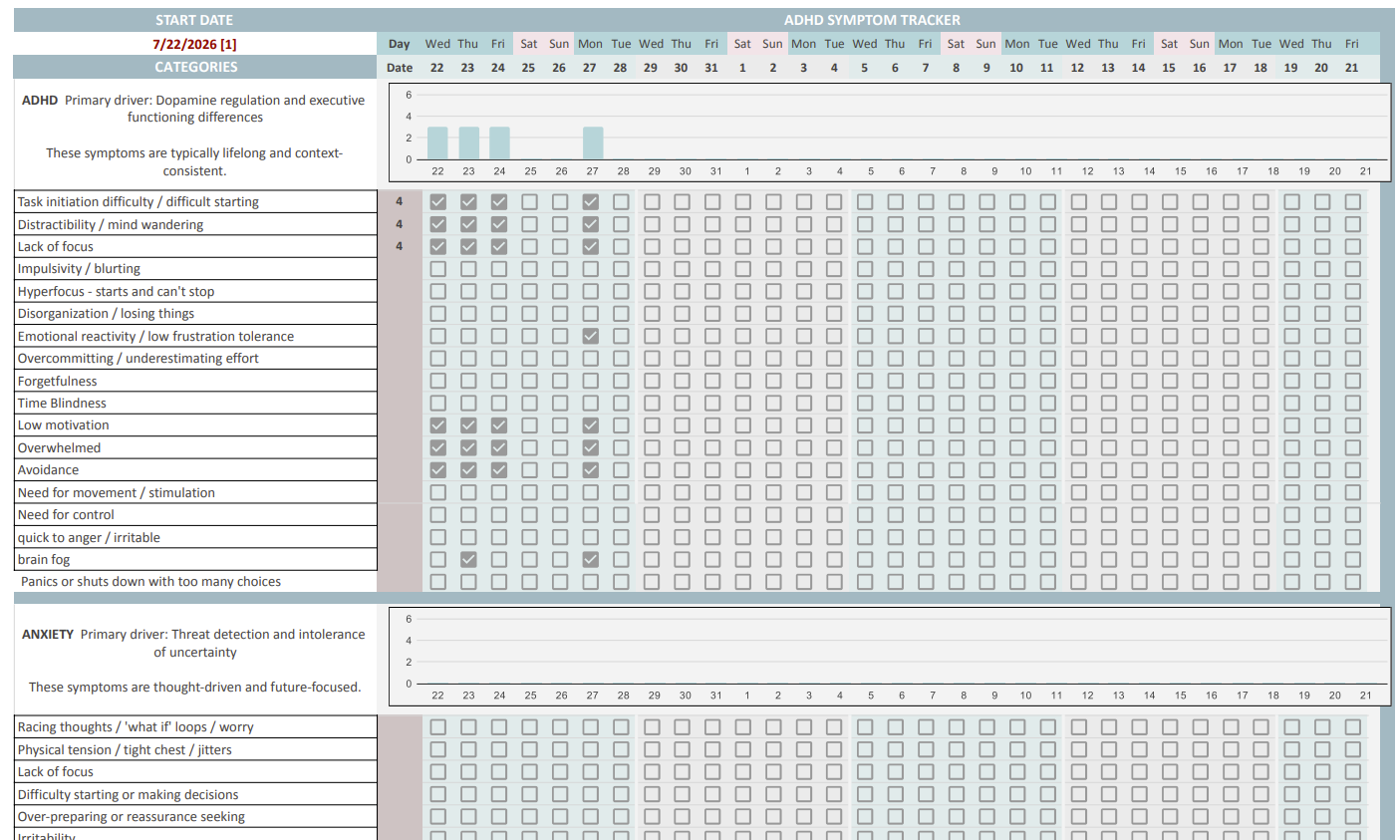
- We’ll use data, homework, learning, and unlearning to start separating what you’re experiencing instead of assuming it’s all ADHD, hormones, or something you just need to try harder to fix. Because each one needs a different type of intervention. A productivity hack was never going to resolve an anxious response.
- Our 30-minute sessions are intentionally focused.
- This isn’t an open-ended How did your week go?
Think of our meeting like a stand-up meeting. We have 30 focused minutes to process the information you’ve gathered, work on the strategy, skill, habit, system, thought, or response we’ve identified, and decide how we want to move forward. - The structure itself is part of the work. You’re practicing how to synthesize what you want to say, stay on topic instead of letting a thought loop take us down a rabbit hole, recognize when the scope needs to adjust, and identify when another iteration needs to be added.
- The time is intentional so you walk away having retained what we worked on instead of thinking, Wait… what did we even do?
- This isn’t an open-ended How did your week go?
- We meet every two weeks. That’s about an hour a month.
- The work doesn’t stop when the clock hits 30 minutes.
- In between sessions, you might:
- collect data
- complete a homework assignment
- practice a different response
- work on a new skill
- try a system or strategy
- change a habit
- test a boundary
- adjust a plan based on your actual time, energy, or capacity
- Maybe we’re changing a fight-or-flight response. Maybe we’re learning how to set boundaries with yourself or other people. Maybe we’re learning time before we tackle time management. Maybe we’re rewriting a rule you taught yourself, like I work better in the morning, and building the flexible thinking.
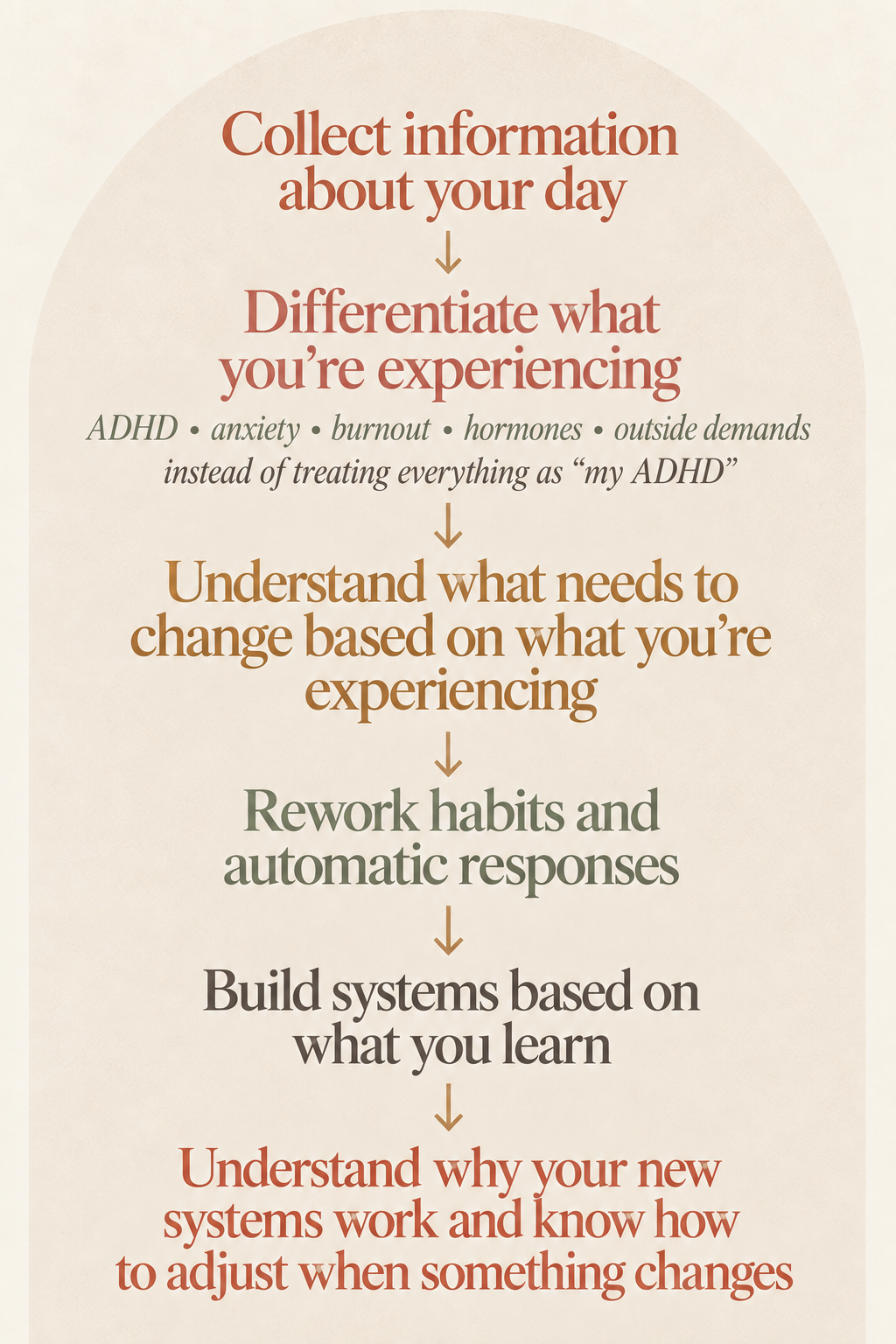
The goal isn’t to find a planner that works until it doesn’t.
We put systems in place. We build habits. We reshape thoughts. We learn what’s affecting your executive functioning and why certain changes actually help.
Your day-to-day starts feeling more aligned. You make room for your own needs alongside everyone else’s. You stop using all of your energy to keep one area of your life going while everything else falls apart.
I’ll teach. You’ll learn.
The goal is for you to understand what’s affecting your executive functioning, what works for you, and why it works so you can recognize when something needs to change and start making adjustments yourself.
Maybe it’s a system. A thought. A plan. The way you’ve organized something. The scope of what you’re asking yourself to do.
Because something will change. Your capacity will change. Your environment will change. Life will change. The goal is for you to know what to do when it does.
- And then we make room for what’s next.
- This work isn’t only about getting through your to-do list. There’s also the bigger question you’ve been asking yourself:
What do I want now?
Your health. Your relationships. Your career. Your home. Your money. Your time. The goals you’ve put off. The things you thought you would have accomplished by now. The parts of your life you want to make room for again. - We’ll start laying that out, turn the bigger picture into goals, and break those goals into things you can actually begin doing.
My background shapes how we’ll work together
Our work together doesn’t fit neatly into the “therapy” or “coaching” box, just like what you’re experiencing may not fit neatly into ADHD, hormones, anxiety, burnout, or one clear explanation. We’re taking an out-of-the-box approach, and our work together might feel more like a Kanban board than a treatment plan.
As a former Special Education Teacher, I know how to teach and adapt information so different people can understand, practice, and apply it.
I’m also a Creative Arts Therapist and Licensed Professional Counselor. We’ll explore symptoms, thoughts, feelings, and responses and make sense of what they’re telling us. We may get into something from your past when it’s relevant, but we’re not spending the entire session there. We have 30 minutes, and we still need time to process the homework you did and set the agenda for what you’re working on next.
I’m also a Project Management Professional (PMP), and from my experience working with clients, I know you’re looking for actionable change and a care trajectory that doesn’t feel open-ended. We might track data in a spreadsheet and look at your day-to-day from a data perspective instead of only an emotional one. We define what we’re working on, the overall goal and timeline.
And I’m a woman who has had to advocate for herself in healthcare, too. I’ve experienced the gaps that can happen when women’s mental health, hormonal health, and executive functioning are treated like completely separate conversations. I’m not a doctor and I can’t prescribe medication. But I am a Certified Menopause Coach, which means hormonal changes and the overlapping symptoms that may be affecting your regulation and executive functioning can be a part of the conversation instead of automatically being segmented out from the rest of what you’re experiencing.
I’ve been working with neurodivergent individuals since 2009, and each part of my education and experience helps shape how we’ll work together.
If you’re ready to get started,